This, too, shall pass: why To USA launched a presidential-term countdown
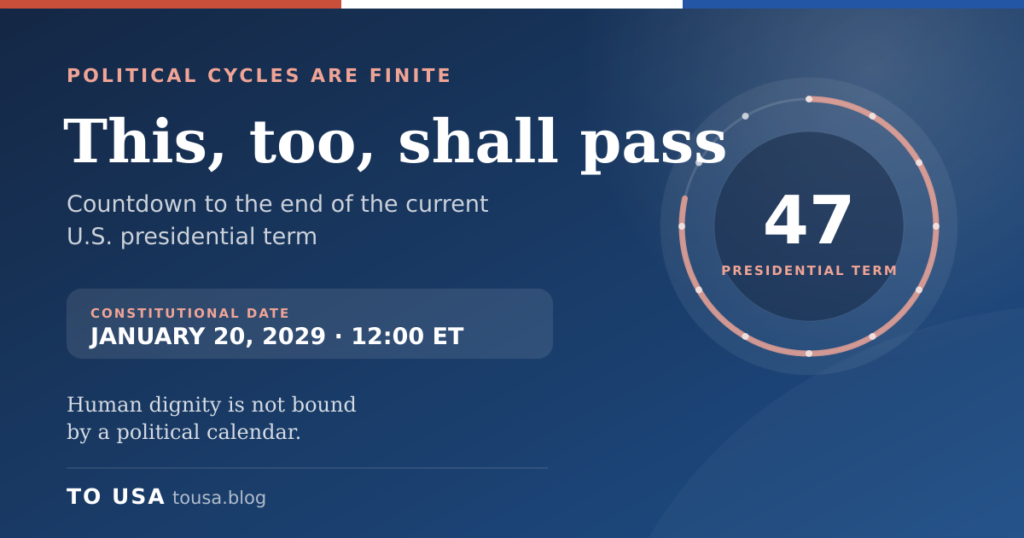
To USA’s home page now includes a countdown to noon Eastern Time on January 20, 2029—the moment when the current presidential term is scheduled to end under the Twentieth Amendment to the U.S. Constitution.
Above the countdown are four words: “This, too, shall pass.”
This is not a promise that every problem will disappear after a particular date. It is not a celebration at the expense of political opponents, nor is it an invitation to put life on hold until the next election. For me, it is a reminder that governments change, political cycles end, and human dignity should not depend on who occupies the White House at any given moment.
Why this countdown exists now
Back in November 2024, I followed the presidential election very closely. I understood that if Donald Trump returned to the White House, life for immigrants in the United States could become much more difficult. Unfortunately, many of my fears have proved justified.

I do not believe that a country lacks the right to control its borders and establish immigration rules. Of course it has that right. Congress and the federal government may determine the conditions under which people enter and remain in the United States. If a person commits a crime that constitutes a legal ground for removal, the government may detain that person and begin the process established by law.
But there is an enormous difference between enforcing the law and trying to detain as many people as possible.
What alarms me is how broadly the current administration uses the word “illegals.” Political rhetoric increasingly places people with entirely different histories into one faceless category: people who are actually evading the authorities, people whose cases remain pending, asylum seekers, participants in humanitarian programs, and people whom the U.S. government itself allowed to enter under procedures it created.
Many of my friends, acquaintances, and clients are immigrants. I do not see an abstract statistic. I see real people who work, pay taxes, raise children, and wait for years for the government to decide their cases. I believe many of them are being treated unfairly today.
One label cannot describe millions of different cases
People without U.S. passports or green cards may include holders of valid visas and nonimmigrant status, people with temporary protections, people granted humanitarian parole, asylum applicants, respondents in immigration-court proceedings, employment-authorization holders, and applicants awaiting decisions on Form I-485. These categories carry different rights, restrictions, and risks. A pending application also does not always confer lawful immigration status; every case must be evaluated individually.
Even USCIS’s official guidance on alien registration lists different categories of people and emphasizes separately that registration itself does not create immigration status. Honest public discussion therefore requires precise language, not one political label for everyone.
One example is the group of people who, while CBP One appointments were available, received appointments, appeared at official ports of entry, underwent inspection, and were then processed under individual government decisions, including grants of parole. The Department of Homeland Security itself described CBP One as a way to provide information in advance and schedule an appearance at a port of entry.
Precision matters: parole is not admission on a visa and is not legally considered an admission in the ordinary sense. A pending asylum application also does not always mean that a person holds lawful immigration status. But these people did not hide from the government. They appeared where the government told them to appear, underwent screening, provided their information, and then exercised the right provided by law to seek asylum. After the required waiting period, applicants may request employment authorization; USCIS expressly provides that option for people with pending asylum applications.
When civil detention feels like punishment
Today, even people in these circumstances may face immigration detention. Formally, immigration detention is civil rather than criminal custody. But for a person deprived of liberty and placed in a secured facility, that distinction hardly makes the experience less severe. It means isolation, separation from family, limited ability to work on one’s case, and the burden of defending one’s rights under difficult conditions.
ICE states that most people on its docket are not detained. But the possibility of detention for even a relatively small part of an enormous population—combined with the scale of enforcement operations and harsh public rhetoric—reaches far beyond detention centers. Fear spreads to people who are participating in the process in good faith and waiting for decisions.
It is especially difficult to accept the detention of a person who has not been convicted of a crime, has not gone into hiding, and continues to wait for a decision. A person should not become a convenient target simply because the government system is overloaded and unable to decide an application within a reasonable time.
I lived through that waiting myself
This issue is especially personal to me. I once waited for asylum while my case was pending in immigration court, with my next hearing scheduled for 2026. I was fortunate: I met my future husband, a U.S. citizen, and later obtained a green card through our marriage. But that process, too, was long, difficult, and emotionally exhausting.
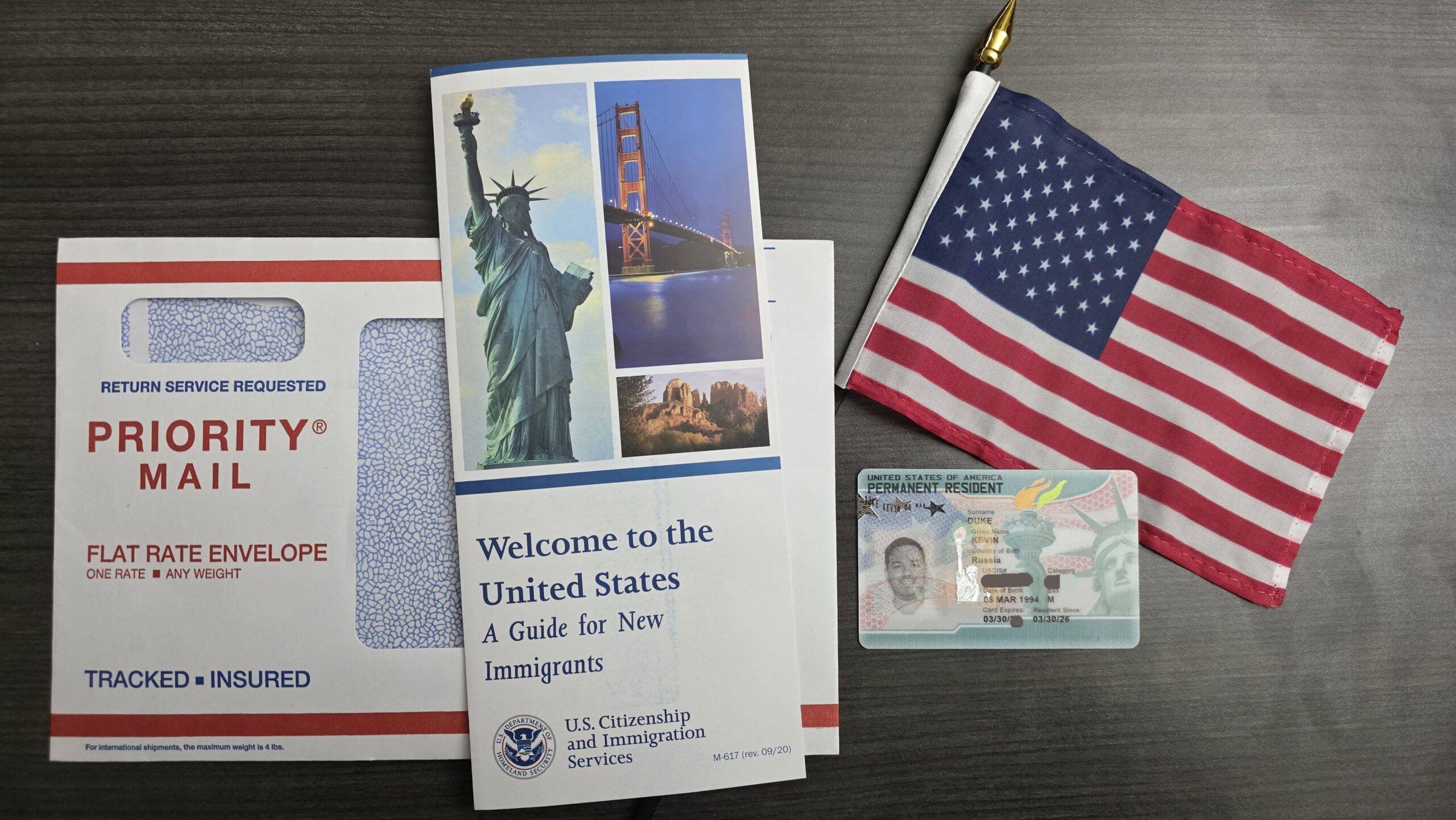
That is why I understand what it means to spend years waiting for an answer. You build a life, work, and follow the rules, while the most important decision about your future always remains somewhere ahead.
I agree that the U.S. immigration system needs reform. But its central task should not be filling detention centers with people who have committed no crimes. It should be deciding cases fairly and on time. That requires USCIS officers, immigration judges, interpreters, administrative staff, and a modern system for processing documents.
Even after a significant reduction in the backlog, EOIR reported in September 2025 that approximately 3.75 million cases remained pending in the immigration courts. EOIR publishes current workload and adjudication statistics separately. Behind every number in that backlog is a person who may wait years for a decision.
If the government believes that a particular applicant does not qualify for asylum, it should examine the evidence and issue a decision with due process. That is why USCIS and the immigration courts exist. Making someone wait indefinitely and then detaining that person after years of compliance does not resemble either effective reform or fair enforcement.
Ukrainians and life in temporary status
It is especially painful for me to watch what is happening to Ukrainian citizens. After Russia’s full-scale invasion, the United States created Uniting for Ukraine and allowed Ukrainians to come here with sponsors. Many of those people are now living with uncertainty again: their parole periods and work permits are expiring, applications take a long time to process, and the cost of preserving the ability to remain and work keeps rising.
USCIS continues to describe a re-parole process for certain Ukrainian citizens, but eligibility to file does not guarantee a timely decision. When a new period of parole or re-parole is approved, USCIS generally charges a separate immigration parole fee unless an exception applies.
As of September 5, 2026, USCIS also states that TPS for Ukraine and related benefits are scheduled to terminate on October 19, 2026. That information appears on USCIS’s current TPS page for Ukraine and in its September 3, 2026 update. Those statements cannot automatically be applied to every Ukrainian citizen or every U4U participant: the legal consequences depend on the particular program, date of entry, period of parole granted, applications filed, and any applicable court decisions.
People pay the fees set by the government, submit their documents, and then spend months not knowing whether they will be able to keep working legally tomorrow. It seems especially unfair to invite people fleeing a war and then leave them in this suspended state.
DV-2027: another warning sign
Another troubling example is Diversity Visa 2027. In November 2025, the Department of State announced that it was changing the registration process and would announce new dates later. At the same time, it said the visa-issuance period for selectees would remain unchanged: October 1, 2026, through September 30, 2027. That is what the Department’s official announcement states. Yet as of the preparation of this article, registration has not begun and no opening date has been announced.
I consider this silence unacceptable. Unless and until a court rules on the issue, I do not want to substitute my judgment for the court’s or categorically claim that particular officials have already violated the law. But the prolonged delay raises a serious question: can the executive branch fully implement the program Congress established within the deadlines governing DV-2027?
To USA is currently conducting a journalistic investigation into the reasons for the DV-2027 delay. We have sent inquiries to the Department of State, relevant congressional committees, and the offices of elected representatives, as well as a Freedom of Information Act request. We are still waiting for substantive responses. We reported our initial findings and the legal questions in “DV-2027 Is Still Not Open: What the Law Requires and What To USA Has Asked.” After we receive additional responses and records, the editorial team will publish a separate, detailed report.
What “This, too, shall pass” means
All of this is part of the reason To USA placed the countdown on its website.
It does not advocate violence, a coup, or anyone’s removal from office before the end of a lawful term. On the contrary, it counts down to the date established by the Constitution itself: under the Twentieth Amendment, a president’s term ends at noon on January 20.
The phrase does not mean passivity. While the clock is running, people still need to file forms, meet deadlines, preserve documents, seek qualified assistance, support one another, and defend their rights through lawful means.
The countdown also does not mean that the next administration will automatically be better or resolve problems accumulated over decades. But I hope that a future government will focus not on competing to appear harsher, but on genuine reform: setting clear rules, ensuring reasonable processing times, preserving meaningful protection for those who need it, and distinguishing between a threat to public safety and a person who is participating in a lawful process in good faith.
Despite everything that is happening, I continue to believe in American democracy and the resilience of its institutions. People protest, organizations go to court, judges review executive actions, and voters have the opportunity to change the balance of power in the midterm elections. Sometimes the system moves painfully slowly. Sometimes harm occurs before a court can issue a ruling. But the system is still working—and that is why criticism of the government, public debate, and participation in elections matter.
For me, this countdown is not only an expression of disagreement with Donald Trump’s policies. It is a reminder that political power in the United States is limited by law and by time.
Political cycles end. Human dignity does not.
This, too, shall pass.

Download the countdown and share it
If this idea resonates with you, you can place the countdown on your own platform. An interactive widget with automatically updating time can be embedded on a website. For Facebook, Telegram, Instagram, and Stories, we have prepared separate cards in the appropriate dimensions. Social networks do not allow a functioning external widget inside an ordinary post, so you can share an image together with a link to the countdown.
Use the tools below to copy the link, share it from your phone, download ready-made images, or obtain the code needed to embed the countdown on a website. The materials are free to use as long as the To USA credit and an active link to the project remain in place.
This is an opinion column and general information, not legal advice. Immigration consequences depend on the facts of each individual case.