
DV-2027 Is Still Not Open: What the Law Requires and What To USA Has Asked
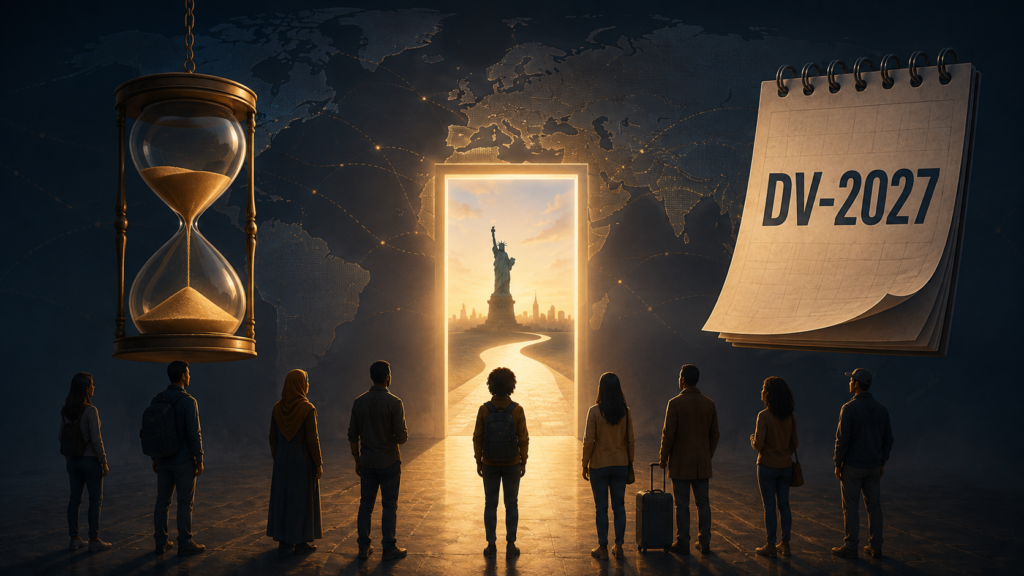
As of August 29, 2026, registration for the Diversity Visa 2027 program — DV-2027 — has still not opened. The U.S. Department of State has published neither the official instructions nor the registration dates.
The Department’s last direct announcement came on November 5, 2025. It said changes were being made to the DV entry process and that the registration start date would be announced “as soon as practicable.” At the same time, the Department confirmed that the visa application period for people selected in DV-2027 would remain October 1, 2026 through September 30, 2027.
The rules have since changed. Effective April 10, 2026, most entrants must provide information from a valid, unexpired passport and upload an image of the passport’s biographic and signature page, subject to limited exceptions. A $1 registration fee has also been adopted. In its final rule, the Department expressly connected the deferred opening of DV-2027 to implementation of the passport requirement. Yet it also said the system had been tested and that no further delay was necessary to accommodate the changes.
Registration nevertheless remains closed.
How the October tradition developed
The modern Diversity Visa program was created by section 131 of the Immigration Act of 1990 and began in fiscal year 1995. It originally provided for as many as 55,000 visas annually; the number effectively available was later reduced.
October was not always the registration month. Entries for the first DV-1 lottery were submitted by mail from June 1 through June 30, 1994, while the DV-96 entry period ran from January 31 through March 1, 1995. An October opening is therefore an administrative convention, not a separate statutory command.
Under the modern electronic system, registration has generally opened in the first days of October and continued for about five weeks. For example, the DV-2026 entry period ran from October 2 through November 7, 2024. There have been technical departures. The original DV-2019 period opened on October 3, 2017, but a system problem prevented the Department from receiving complete information from some entrants. The Department voided entries submitted before the system was stopped and restarted registration from October 18 through November 22, 2017.
It would therefore be inaccurate to say that the lottery is legally required to open in October. But October has become the settled modern practice, and the absence of even an announced date by the end of August is a sharp departure from the familiar calendar.
What the law requires
The Diversity Visa program does not exist merely at the discretion of a president or an agency. Congress established its annual statutory framework in section 203(c) of the Immigration and Nationality Act, codified at 8 U.S.C. § 1153(c).
Another provision, 8 U.S.C. § 1154(a)(1)(I)(ii)(I), states that the Secretary of State shall designate a period for filing petitions for diversity visas for the fiscal year that begins after that filing period ends.
The Department’s current regulation is even more specific. Under 22 C.F.R. § 42.33(b)(4), the Department must establish a period of at least 30 days during each fiscal year for submissions relating to visa issuance during the following fiscal year.
The federal fiscal year ends on September 30. Under the ordinary reading of these provisions, the DV-2027 entry period should therefore occur during fiscal year 2026 and last at least 30 days. To fit the entire period before September 30, registration would need to begin no later than the very start of September.
We are not yet declaring that the Department has violated the law. The fiscal year has not ended, and the Department could still announce dates or take a separate regulatory action. But time is nearly gone. If registration extends beyond September 30, the Department will face a direct question about its legal authority and how that timetable can be reconciled with the text of the statute and its own regulation.
Is the pause on DV issuance still in effect?
As of August 29, 2026, To USA has found no official notice rescinding the DV-specific pause. The Department’s active guidance still states that, effective December 23, 2025, it paused all diversity immigrant visa issuances with no exceptions. Applicants may still submit applications and attend interviews, and the Department continues scheduling appointments, but no DVs are being issued. This statement concerns consular visa issuance by the Department of State; adjustment of status inside the United States is administered separately by USCIS.
This does not mean that no one has received a DV-2026 visa. The visa year began on October 1, 2025—almost three months before the pause—and some applicants received visas before December 23. The Department publishes monthly immigrant-visa issuance tables for October, November, and December 2025, but expressly warns that the data are preliminary and that individual monthly reports should not simply be added together as a final fiscal-year total. In other words, the pause interrupted an issuance process that was already underway; it did not stop a program that had never started. That is especially dangerous for the remaining selectees because eligibility for DV-2026 visas expires on September 30, 2026 and does not carry over into the next year.
Reports that DV-2026 selectees are looking for financial supporters do not show that the pause has ended. Because interviews continue, applicants still need to prepare complete cases. For example, official instructions from the U.S. Embassy in Ankara explain that a DV applicant must demonstrate that he or she is unlikely to become a public charge and may present personal funds, a U.S. job offer, or Form I-134 from a U.S. financial supporter. Looking for a supporter is preparation for an interview, not evidence that visa issuance has resumed.
This policy should not be confused with a different pause. The January 2026 immigrant-visa pause affecting nationals of 75 countries ceased to be in effect on August 21, 2026 under a court order. The Department’s August 28 update concerns that 75-country policy and does not rescind the separate DV-specific pause.
What To USA has asked
On August 29, To USA sent a series of formal inquiries:
- a media inquiry to the U.S. Department of State asking whether DV-2027 will be conducted, when registration will open, how the Department intends to comply with the 30-day requirement, and whether any amendment, suspension, waiver, or other regulatory action is being considered;
- a Freedom of Information Act request to the Department’s Information Access Programs Directorate seeking records about the delay, proposed dates, internal legal analysis, possible regulatory options, and communications with the White House, OMB/OIRA, and Congress;
- oversight inquiries to the House Foreign Affairs Committee and the Senate Foreign Relations Committee asking them to seek an immediate explanation from the Department;
- inquiries to Washington State Senators Patty Murray and Maria Cantwell and Representative Marilyn Strickland.
In the FOIA request, To USA sought expedited processing, classification as a representative of the news media for fee purposes, and a public-interest fee waiver. As of publication, we have received only technical automated notices, not substantive responses. We are awaiting replies and will continue to follow up.
Why a small website can still do media work
News media are not limited to television networks, major newspapers, or newsrooms with hundreds of employees. In the United States, a website does not need a special government license or a predetermined number of readers before it can engage in journalism. Freedom of the press protects the activity of gathering and publishing information, although particular privileges and procedures have their own legal tests.
FOIA is a useful example. Federal law defines a representative of the news media functionally: a person or entity that gathers information of potential interest to a segment of the public, uses editorial skills to transform raw materials into a distinct work, and distributes that work to an audience. The Department of State’s FOIA fee regulation uses the same definition and expressly recognizes news organizations that publish solely online. Department of Justice training materials further explain that posting on a website can qualify as distribution and that audience size does not matter by itself.
This is not an honorary title or a government endorsement. It describes the work being done. To USA gathers information, checks sources, contacts government institutions, applies editorial judgment, and publishes for readers. We intend to use the tools available to a publication — press inquiries, FOIA, and requests for congressional oversight — to try to produce a concrete public benefit.
Why DV-2027 matters
For millions of people, the green card lottery remains one of the few direct, lawful ways to immigrate to the United States without an employer or a close relative filing a petition. The odds are small, and selection never guarantees a visa, but for many families it is a genuine opportunity that would not otherwise exist.
Donald Trump has opposed the lottery for years. This is not an inference: in February 2018, the White House published his direct call for Congress to “immediately terminate” the program and his proposal to reallocate the visas assigned to it. But Congress created the program, and while section 203(c) of the INA remains in force, a president cannot simply erase it from the U.S. Code. That is why transparency, compliance with existing law, and public scrutiny of the program’s administration matter.
This article is a short introduction. After we receive responses from the Department of State, congressional committees, and elected representatives — and as the FOIA request progresses — To USA will publish a more detailed report with the documents, a fuller legal analysis, possible scenarios, and practical consequences for prospective DV-2027 entrants.
What will be updated. If the Department first announces registration dates, To USA will publish a separate short notice with the opening and closing dates, the official entry link, and the principal filing conditions, and then update this article. After substantive responses arrive, we will publish a separate detailed analysis and, when permitted, the records we receive.
Related: more To USA coverage of U.S. immigration.
This article is for general information and is not legal advice.


Comments